Used machines for sale
Main brands:
Búfalo, Exakt, G.Mazzoni, Hermann, Jaf Inox, Leogap, Maschinenfabrik Heidenau, Mazzoni, Mazzoni LB, Melg, Muller, OLIVER + BATLLE, PILON, Probat
|
| Roller mills |
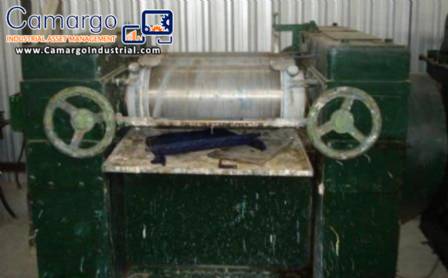
A roller mill is an industrial equipment that crushes, grinds, or refines solid materials through compression and friction between rotating rollers. It can have one, two, three, or more rollers, depending on the application.
The material is fed between the rollers, where it is crushed until it reaches the desired particle size. It is used in the chemical, cement, food, coal, ceramic, and metallurgical industries.
The roller mill is used to:
- Reduce large particles into smaller particles (grinding).
- Homogenize mixtures and ensure product uniformity.
- Pre-crushing raw materials before other processes.
- Particle size control in final products (e.g., chocolate or pigments).
Types of roller mills:
- Single roller mill:
Principle: A single roller compresses the material against a fixed surface.
Characteristics: Low capacity, suitable for soft or friable materials.
Industries that use it: ceramics (clays), small coal industries, and pre-crushing of friable minerals.
- Double roller mill:
Principle: Two rollers rotating in opposite directions crush the material.
Characteristics: More efficient than the single roller; continuous and uniform grinding.
Industries that use it: cement (pre-grinding of limestone), pulverized coal, chemical industry (minerals, gypsum), clays and ores.
- Three-cylinder roller mill (3 rollers):
Principle: Two lower rollers and one upper roller compress the material gradually.
Characteristics: Higher capacity, uniform particle size, fewer unwanted fines.
Industries that use it: cement (grinding of clinker and limestone), pigments and fine chemicals, pulverized coal, food (chocolate, peanut butter, cocoa, sweets), and the PET and veterinary industry.
- Multi-roller mills (4 or more rollers):
Principle: Several rollers compress the material; generally used for fine grinding or precise particle size control.
Characteristics: High uniformity, suitable for hard or sensitive materials.
Industries that use them: hard ores and metals, fine pigments, specialty chemicals, gourmet chocolates, and high-quality food pastes.
Roller mills can be manufactured with different materials, depending on the application, abrasiveness of the material to be ground, and hygiene or corrosion resistance requirements.
Carbon steel: This is the most common material in mills used in the cement, coal, and mining industries. It offers good mechanical resistance and is relatively inexpensive, making it ideal for abrasive and heavy materials.
Cast iron: Used in heavy industries, especially for ores and highly abrasive materials. Cast iron has high abrasion resistance and good mechanical performance, but is heavier and less resistant to corrosion.
Stainless steel (inox): Essential in the food, pharmaceutical, and fine chemical industries, where hygiene and corrosion resistance are fundamental. Stainless steel prevents product contamination and facilitates cleaning, making it ideal for grinding chocolate, cocoa, food pastes, and sensitive chemical powders.
Steel with special coatings (rubber, ceramic, or polymers): Used for highly abrasive or contamination-sensitive products. The coating reduces equipment wear, protects the material, and prevents unwanted chemical reactions. |
|
|
|
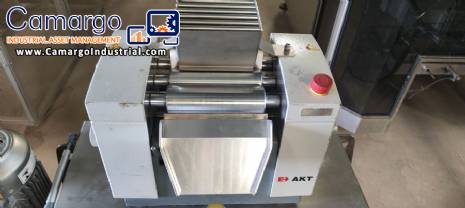 |
Brand: Exakt
Three-roll refiner for benchtop cylinders for R&D laboratories, quality control or micro-production of food, cosmetics, chemical industry among other sectors.
Manufacturer brand: Exakt three roll mill Germany.
Year: 2015.... |
|
|
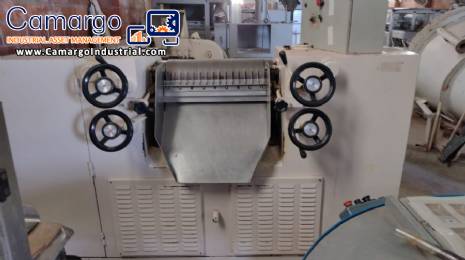 |
Brand: G.Mazzoni, Mazzoni, Mazzoni LB
Refining mill with 3 cylinders, 600 mm wide.
Brand: G.Mazzoni.
With equipment control panel.
Approximate dimensions:
Length: 720 mm Useful: 600 mm.
Diameter: 250 mm.
Engine: 20 HP.... |
|
|
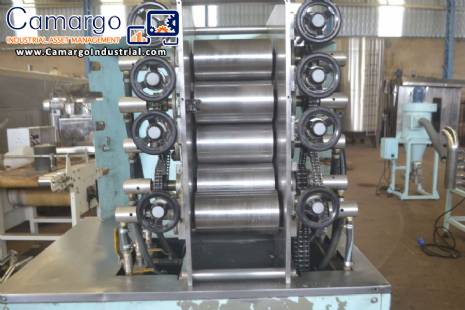 |
Brand: Jaf Inox
5-roll refiner with cooler.
Brand: JAF Inox.
Dimensions:
Width: 700mm.
Length: 1.00 m.
Height: 1.70 m.
Cylinder length: 200 mm.... |
|
|
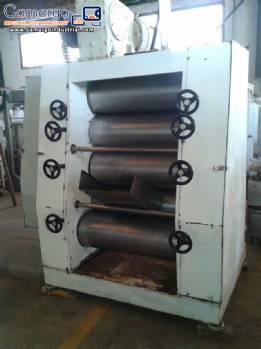 |
Brand: Búfalo
Drum refiner of masses, chocolate and others.
Stainless steel rollers.
Stainless steel with 5 cylinders.
Voltage: 380 V-60 Hz, 1780 rpm.
Diameter: 360 mm.
length: 880 mm.
run Diameter: 300 mm.... |
|
|
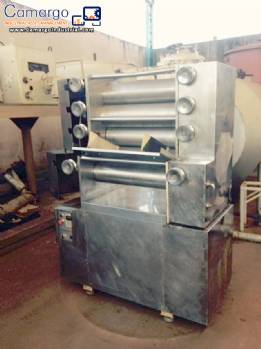 |
Brand: Jaf Inox
5 roller refiner.
Brand: Jaf.
Stainless steel equipment.
Measures of rollers: 0.80 X 1.50 in diameter length.
since the bean cleaning, roasting, shovel, conching, tempering, molding and enrobing.
Note: it is especially designed for chocol... |
|
|
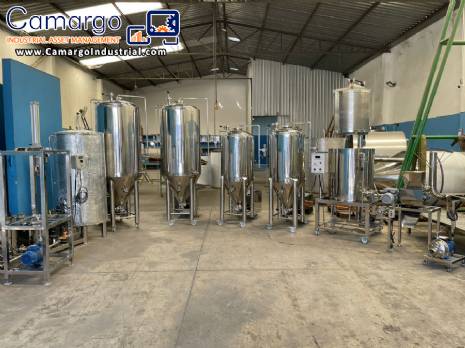 |
Microbrewery Beer Production Line
Manufacturer: CBB-Biomassa e Bioprocesso Ltda.
Equipment Manufacturing Year: 2024
Active Operating Time: 24 months
Capacity: 600 to 750 liters of ready-to-brew craft beer per month
Composed of: mill, s... |
|
|
 |
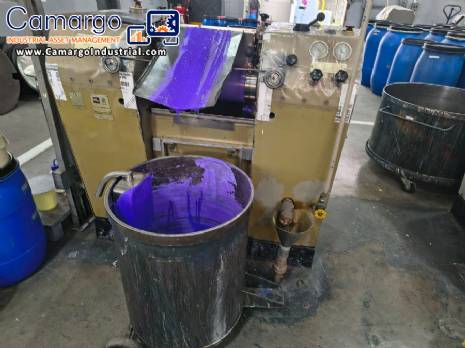
Brand: OLIVER + BATLLE
Three-cylinder roller refiner mill.
Manufacturer | Brand: OLIVER + BATLLE (Miralles).
Approximate capacity: up to 230 liters of ink per hour.
Year: 1995.
Used for grinding screen printing inks.
Features 3 horizontal polished steel roll... |
|
|
 |
Brand: OLIVER + BATLLE
Three-cylinder roller refiner mill.
Manufacturer | Brand: OLIVER + BATLLE.
Model: G-150H.
Approximate capacity: up to 150 liters of paint per hour.
With 220V three-phase motor.
Year: 1998.
The equipment operated for 28 years and is ... |
|
|
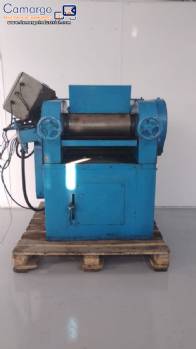 |
Components: VARIMOT
Double-roller, double-cylinder refining mill.
For refining, homogenizing, and dispersing industrial pastes, pastes, pigments, and compounds.
Robust construction in heavy metal structure.
With VARIMOT speed control system and mechanical cylin... |
|
|
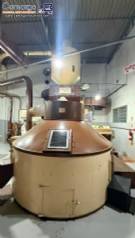 |
Brand: ABIS Machines, Inmac, Leogap, OPEM
Coffee roasting line with roaster silos, grinder, and packaging machine.
Capacity / hour:
Vacuum-packed roasted and ground coffee: 4,200 packages per hour / 2,100 kg per hour.
Pillow-packed roasted and ground coffee: 2,000 packages per hour ... |
|
|
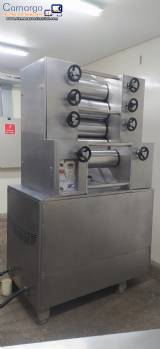 |
Brand: Jaf Inox
Set of mills for making fine chocolates.
Manufacturer | Brand: JAF INOX.
The set contains:
- Knife mill.
Approximate capacity: up to 30 kg per batch.
With a buffer tank with a storage capacity of 90 kg and a pumping system.
- Roller... |
|
|
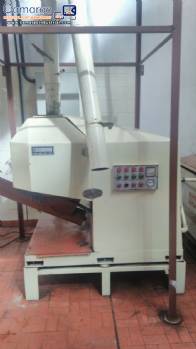 |
Brand: Melg
Roller mill for coffee.
Manufacturer / brand: Melg.
Model: 4G 1000.
Water-cooled system.
For grinding coffee.
Approximate capacity: up to 1000 kg per hour.... |
|
|
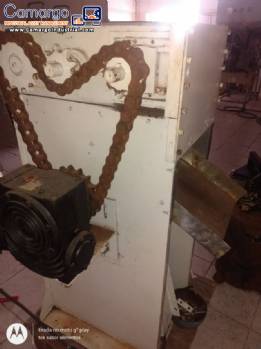 |
Roll mill.
Ground black pepper.
It produced 100 kg per hour on average.... |
|
|
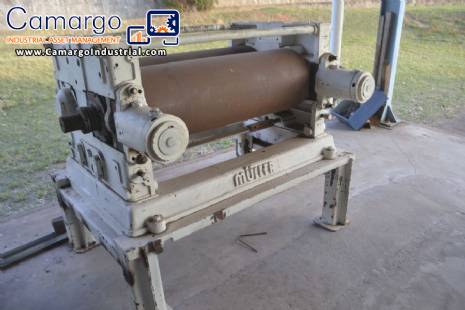 |
Brand: Muller
Two roller/cylinder horizontal refiner.
Manufacturer: Muller.
Approximate Dimensions:
Height: 1.40 m
Length: 1.80 m
Width: 1.25 m... |
|
|
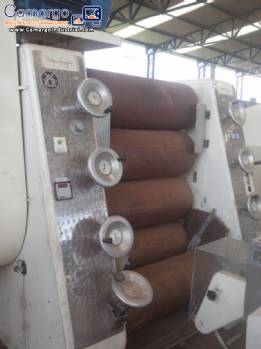 |
Brand: Hermann
Chocolate refining cylinder with 5 rolls
Hermann.
Mark Model FW-50
Measuring each 1.20 roll length
cylinder 2.78 Measures height x width x length 1.55 2.60... |
|
|
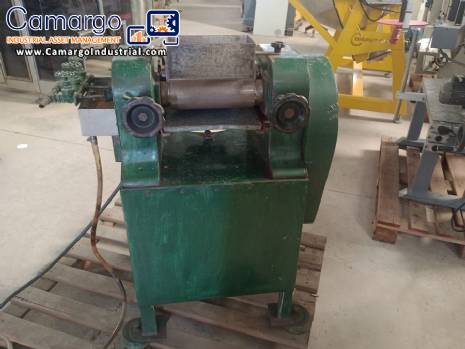 |
Carbon steel roller refining mill.
Cylinder length: 250 mm.
For paints, grease and others.
Voltage: 220 V three-phase.
Approximate dimensions:
Height: 1.30 meters.
Width: 1.10 meters.
Length: 1.20 meters.... |
|
|
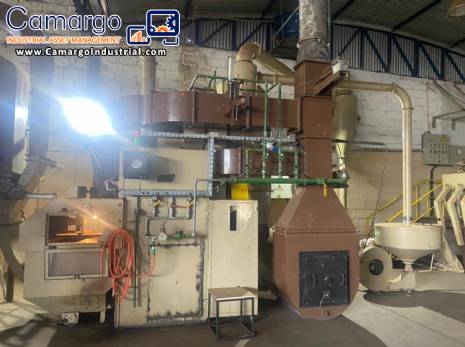 |
Brand: Cetro, Lilla
Line for making coffee.
To produce roasted and ground coffee, vacuum coffee and espresso coffee.
Line composed of:
- Coffee roaster.
Manufacturer: Lilla.
Approximate capacity: 80 kg every 7 minutes.
With automatic PLC.
- Three si... |
|
|
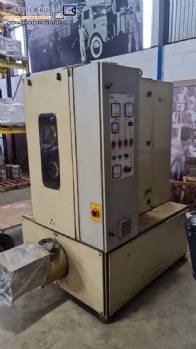 |
Brand: Leogap
Roller mill for grinding roasted coffee.
Manufacturer: Leogap.
Model: MRAL 2250.
Year: 2002.
Approximate capacity: 2250 kg per hour.... |
|
|
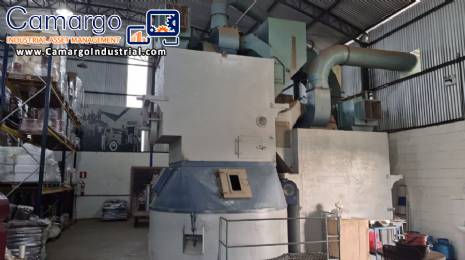 |
Brand: Leogap, Probat
Coffee roaster.
Manufacturer: Probat Leogap.
Approximate capacity: 2700 kg per hour.
Approximate capacity: up to 6 bags.
Year: 1998.
A complete renovation of the thermal insulation was carried out.... |
|
|
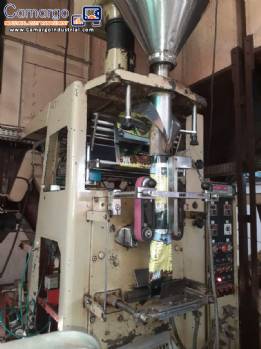 |
Brand: Fabrima, Melg
- Packing machine for packing roasted and ground coffee.
Manufacturer: Fabrima.
Model: 026.
Year: 1981.
Approximate capacity: 1,000 kg / hour.
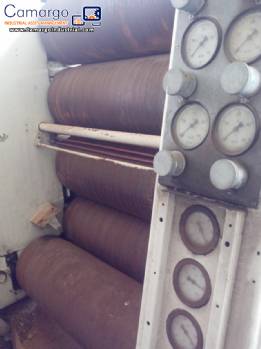
- Roll coffee grinder.
Manufacturer: MELG.
Model: 500
Approximate capacity: 400 kg ... |
|
|
 |
Brand: Maschinenfabrik Heidenau
Refiner with 5 rolls brand Maschinenfabrik Heidenau 1.25 each roll length
... |
|
|
 |
Brand: PILON
05 roller mills (450 mm) mark pilon
01 600 mm roller mill brand and ROUSSELE. * k12k. * The equipment is fully operational.
... |
|
|
| |
| |
|