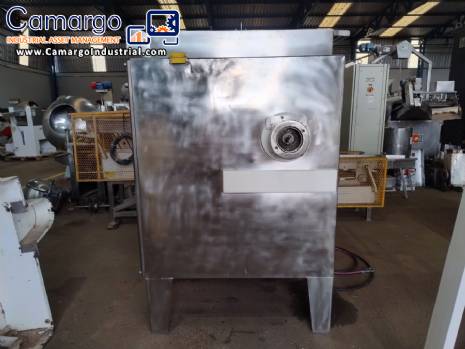
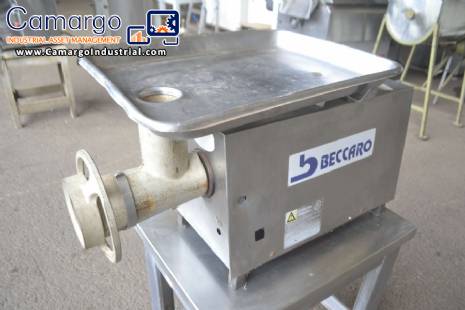
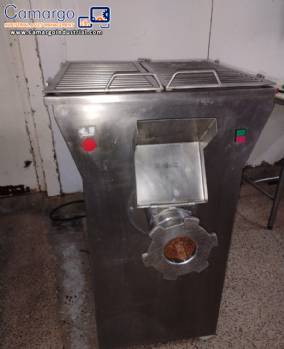
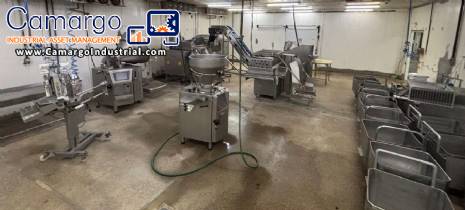
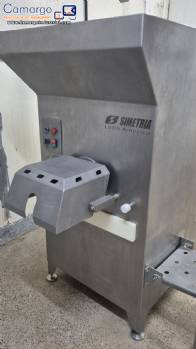
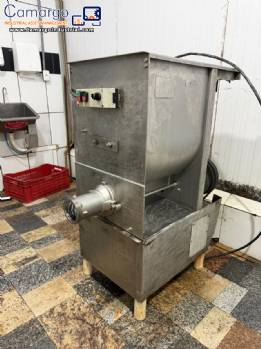
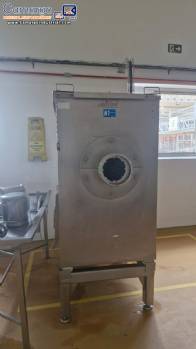
An industrial meat grinder is equipment used to reduce and standardize the particle size of meats and other food raw materials. The process is carried out through a feeding system, a screw conveyor, and a cutting assembly typically composed of pre-cutters, knives, and discs.
During operation, the raw material is fed into the machine and conveyed by the screw to the cutting assembly. The knives cut the product, while the discs determine the output particle size. The use of discs with different hole diameters allows for coarse, medium, or fine grinding, according to the characteristics of the product and the needs of the process.
In the meat industry, this equipment can process beef, pork, poultry, fish, fats, and other raw materials of animal origin. Grinding can be the final step in obtaining ground meat or be part of the preparation of products such as hamburgers, sausages, salami, meatballs, kibbeh, cured meats, meat fillings, molded products, breaded products, and other processed meat-based foods.
Depending on the design, cutting system, and equipment configuration, industrial grinders can also be used to process other food raw materials, such as fruits, vegetables, legumes, cheeses, nuts, peanuts, fats, vegetable ingredients, and pasta, among other products that require size reduction or particle size standardization.
There are models developed to work with fresh, chilled, partially frozen, or frozen products; it is necessary to observe the specifications of each piece of equipment regarding the temperature, size, and consistency of the raw material.
Industrial grinders are available in different mouth sizes, with common measurements being 106, 110, 114, 130, 160, 200, 220, and 250 mm. The mouth size is mainly related to the size of the grinding unit and the processing capacity of the machine.
- Mouths from 106 to 114 mm: mainly used in small and medium-sized productions, capable of processing meats, fats, and other compatible raw materials.
- 130 mm mouth: common in intermediate productions and industrial lines for processing meats and food products.
- 160 mm mouth: used in higher-capacity industrial operations, including continuous processes.
- 200 and 220 mm mouths: mainly intended for large production lines and the processing of high volumes of raw materials.
- 250 mm mouth: found in high-capacity equipment, typically used in large industrial plants.
The size of the feed opening alone does not determine the type of product that can be processed. Grinders with different diameters can work with similar raw materials. The main differences are related to production capacity, installed power, size of feed parts, cutting system, desired particle size, and product conditions.
Main types of industrial grinders:
- Conventional grinder: mainly used for grinding fresh or chilled meats, pre-sized for feeding the machine. The particle size can be altered by changing the discs and components of the cutting assembly.
- Continuous grinder: developed for continuous operation in industrial lines. It can receive raw material through elevators, conveyors, screws, or other feeding systems and discharge the product directly to the next stage of the process.
- Grinder for frozen products: has a construction, power, and cutting system suitable for working with raw materials at low temperatures. The temperature and maximum feed size depend on the specifications of each piece of equipment.
- Mixer grinder: combines the homogenization or movement of raw materials with grinding, being used in processes involving meats, fats, and other ingredients.
- Grinder with denervator: in addition to grinding, it has a system designed to assist in separating nerves, cartilage, and other unwanted particles from the raw material.
- High-capacity grinder: larger equipment, usually equipped with larger openings, more powerful motors, and continuous feeding systems, intended for processing large volumes of product.
Grinders are widely used in meat processing plants, meat processing industries, sausage and sausage factories, hamburger industries, poultry and fish processors, and processed food industries. When designed for other raw materials, they can also be used in fruit and vegetable industries, dairy and cheese industries, nut and peanut-based products, and other areas of the food industry. |