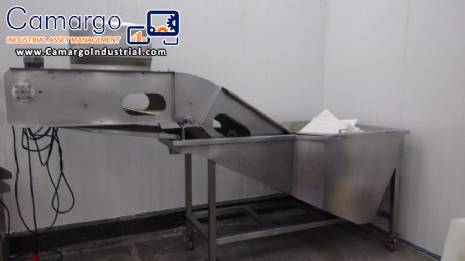
Fish washers are industrial equipment designed to wash fish, seafood, and other seafood products, removing impurities such as blood, mucus, sand, ice residue, or transport dirt. This type of machine is widely used in fish processing industries, fishmongers, cold storage facilities, and seafood export companies, ensuring hygiene, preservation, and product quality before steps such as filleting, freezing, or packaging.
Applications:
Cleaning fish after capture or reception.
Reduction of microorganisms on the surface.
Preparation for subsequent processes, such as cutting, filleting, or freezing.
Optimization of hygiene and product standardization.
Types of fish washers
There are different designs and washing systems, depending on the type and volume of fish:
- Water jet washers (pressure washing):
Use high-pressure water jets to remove dirt and residue from the surface of the fish.
Most commonly used for whole fish or large volumes.
- Rotary or drum washers:
The fish is placed in a rotating drum with running water.
Movement helps loosen dirt and ice residue.
Common for small fish and crustaceans.
- Conveyor belt washers:
The fish is carried by a conveyor belt while jets of water wash the product.
A good option for continuous production lines, ensuring a constant flow.
- Brush washers:
For species with a more resistant surface, such as some crustaceans or large fish.
Rotating brushes help remove adhered dirt.
- Combined washers:
They mix water jets, rotating drum and conveyor belt, depending on the volume and type of fish.
Types of companies that can use fish washers in the industrial process:
- Fish processing plants: They wash, process, freeze and package fish and seafood.
Example of products: tilapia fillets, salmon, frozen shrimp.
Characteristics: automated lines, high volume, need for rigorous hygiene.
- Seafood processing and beneficiation industries:
Companies that receive raw fish and perform cleaning, peeling, cutting, and packaging.
Washers used for whole fish, shrimp, squid, and mollusks.
Typically geared towards the export market or supermarkets.
- Industrial and wholesale fishmongers:
Washing of fish for sale in large quantities.
Can be semi-industrial (smaller scale) or industrial (conveyor belts, rotating drum).
- Fishing cooperatives:
Artisanal or semi-industrial fishing.
Some cooperatives invest in washers to standardize products before sale or export.
- Fish processing centers for export:
High hygiene standards.
Automatic washers and disinfection systems. Products ready for international supermarkets. |