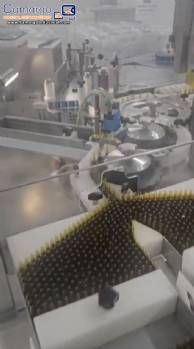
1. Operating Principle
Unlike linear machines (where the vial moves straight along a conveyor), the rotary machine offers positive control of the vial from the beginning to the end of the process.
Glass vials (usually Type 1 borosilicate glass) are small, unstable, and contain high-value medicines. In the rotary system, the vial does not vibrate or suffer uncontrolled friction. It is "embraced" and rotates on its own axis with millimeter precision. This ensures a label application without bubbles or wrinkles at very high speeds (from 200 to over 800 vials per minute), minimizing the risk of breakage on the line.
2. Machine Architecture and Physical Components
The vial's path requires perfect kinematics. Key mechanical components include:
Infeed Turntable: Receives the vials from the capping machine and organizes them.
Timing Screw (Worm Screw): The first stage of synchronization. It separates clustered vials, creating the exact pitch required by the machine's starwheels.
Infeed and Outfeed Starwheels: Technical polymer toothed wheels that transfer the vials from the timing screw to the carousel, and then from the carousel to the outfeed conveyor.
Central Carousel: The "heart" of the rotary machine. It features lower pucks and upper centering bells that descend and lock the vial by its aluminum flip-off seal.
Labeling Dispenser (Labeling Head): The module that unwinds, codes, reads, and applies the label.
Wipe-down Station: Rubberized rollers or soft brushes that press the label against the spinning glass to cure the adhesive.
3. Web Handling and Waste Management
Managing the label web path is the achilles heel of maintenance. Proper tension control prevents the liner (backing paper) from breaking, which would cause drastic drops in OEE (Overall Equipment Effectiveness).
Motorized Unwinder: Gradually releases the material, avoiding jerks on the heavy reel.
Dancer Arm: A pulley system with springs or cylinders that absorbs the servomotors' jerks during acceleration, keeping the web tension constant.
Peel Plate (Dispensing Edge): An acute-angled plate. When the web bends sharply over it, the stiffness of the label causes it to move straight forward toward the vial, detaching from the liner.
Liner Rewind: Collects the empty liner (glassine or PET) with controlled torque to avoid tearing the web.
Splice Detector: Identifies factory splices on the reel and signals the PLC to reject the vial receiving that specific label.
4. Synchronization Engineering: Mechanical vs. Servomotors
Mechanical Synchronization (Traditional): Uses a main motor connected to cams, pulleys, and gears. Robust, but requires high setup time (format changeover) and suffers from physical wear (backlash).
Servo-driven Synchronization (The Gold Standard): Uses Electronic Camming. Each component (carousel, labeling head, timing screw) has its own independent servomotor. A Master Encoder on the main shaft reads the machine's speed; the PLC adjusts all servomotors in milliseconds. Setup is done via HMI (screen), simply by loading the vial recipe.
5. Signals, Sensors, and Control Loop
Trigger Sensor (Presence Sensor): Notifies the labeling head that the vial has reached the exact application position.
Gap Sensor: Reads the empty space between labels on the reel, determining the precise stopping point for the motor. Uses photoelectric cells for opaque labels or ultrasonic/capacitive sensors for clear labels.
Shift Register: A PLC logic function that "records" the position of a defective vial and tracks its rotation on the carousel to ensure it is ejected at the correct rejection station.
6. Variable Data Printing (Coders)
Integrated before the peel plate, they print Batch, Expiry Date, and 2D codes:
TTO (Thermal Transfer Overprinter): Uses a heated ribbon. High resolution for small texts.
Laser (CO2 or Fiber): Burns the label surface. It is the cleanest technology for classified cleanrooms, with no consumables and no particulate generation.
TIJ (Thermal Inkjet): Fast-drying ink cartridges.
7. Integrated Vision Systems (Track & Trace / Serialization)
To comply with traceability regulations (such as DSCSA or FMD), industrial cameras (e.g., Cognex, Keyence, Antares) inspect 100% of the production:
OCV/OCR: Validates the legibility of the printed batch and expiry date.
Datamatrix Reading: Confirms the 2D code for unit-level serialization.
Physical Inspection: Detects skewed labels, flagging (peeling edges), or missing labels.
Positive Rejection Station: Pneumatic pistons automatically divert rejected vials into a locked Reject Bin without stopping the machine.
8. Substrates and Label Types
Wrap-Around: 360º or partial coverage of the vial body.
Clear-on-Clear: Transparent labels with invisible adhesive, simulating direct printing on glass. Requires ultrasonic reading and UV sensors.
Tamper-Evident: The label extends up to the aluminum flip-off seal, showing evidence of tampering if opened.
Booklet Labels: Thick, "booklet-style" labels for small vials requiring extensive regulatory information (common for 2ml to 10ml).
Hanger Labels: Feature a peel-off section forming a loop to hang larger vials (e.g., anesthetics and IV fluids) on hospital IV stands.
9. Industries and Top Global Manufacturers
Where are they used?
Human Pharmaceuticals: Vaccines, oncology drugs, lyophilized (freeze-dried) products, antibiotics.
Veterinary Pharmaceuticals: Vaccines and hormones (50ml to 250ml vials).
Aesthetics: Botulinum toxin and biostimulators.
The Industry Heavyweights (Global OEMs and Capacities):
The global sterile market is dominated by European and American manufacturers that dictate innovations in Track & Trace and high-speed processing. Below are the leading brands, their vial-focused models, and estimated production ranges:
1. Marchesini Group (Italy)
Global giant in complete line integration. Their labelers are benchmarks for native vision system integration.
Main Models: RE Series (e.g., RE 302, widely used for advanced Track & Trace) and RL-F Series (e.g., RL-F300, RL-F500, RL-F800).
Production Range: From 200 to an impressive 800 vials per minute (on the RL-F800 series).
2. Bausch + Ströbel (Germany)
Absolute traditional experts in sterile filling and labeling lines, operating heavily with isolators and cRABS.
Main Models: ESA Series (e.g., ESA 1025, ESA 1001).
Production Range: Equipment covers everything from pilot scales (150 vpm) to mass productions exceeding 600 vials per minute.
3. Syntegon (Formerly Bosch Packaging - Germany)
Benchmark in modular integration. Their solutions typically align filling, capping, integrity testing (CCIT), and labeling in unified blocks.
Main Models: Modular solutions for RTU (Ready-to-Use), RAN platforms, and their high-speed labeler family.
Production Range: From 150 to 400 - 600 vials per minute, focused on zero defects and extremely high vial stability.
4. Newman Labelling Systems (UK / USA)
Fully dedicated to pharmaceutical labeling (ampoules, vials, and syringes). Famous for extreme precision and compact design.
Main Models: VAL Series (e.g., VAL550, VAL595 for high speed) and NVS Series (e.g., NVS2 for compact productions).
Production Range: The NVS series delivers 120 vials per minute, while the VAL series peaks at 550 to 600 vials per minute.
5. Herma (Germany)
World-renowned for surgically precise applicator heads. Their complete systems for pharmaceutical labeling are state-of-the-art.
Main Model: HERMA 132M HC (Continuous starwheel architecture, Wrap-around).
Production Range: Comfortably reaches 400 vials per minute.
6. NJM / ProMach (USA)
Very strong in the Americas market, offering solutions that balance high technology with setup flexibility.
Main Models: Courser (excellent for vials and syringes) and the BRONCO line.
Production Range: Agile machines aimed at the 150 to 300 vials per minute range.
7. Krones / Gernep (Germany)
Although Krones is the world's biggest name in beverage filling, divisions like Gernep cater to the chemical, cosmeceutical, and veterinary pharmaceutical industries requiring high robustness.
Main Models: Gernep Labetta / Rollina (Customized for small glass vials).
Production Range: Projects can operate at over 600 vials per minute, especially in the Large Volume Parenterals (LVP) market. |