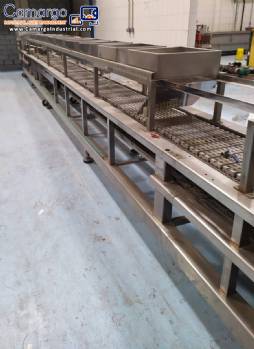
A production line for gelatin candies, gummy candies, and gummies is a set of industrial equipment used to prepare, cook, dose, mold, cool, condition, and finish soft, chewy candies. These products can be made with gelatin, pectin, carrageenan, starch, or other gelling agents, responsible for the characteristic texture of the candies.
Gelatin candies are those whose structure and elasticity are obtained primarily through the use of gelatin in their formulation. Gummy candies are a broader category of soft, gelled candies, which can be produced with gelatin or other gelling agents. The term gummy, originating from English, is widely used to refer to this same type of chewy candy, such as bears, worms, rings, fruits, hearts, bottles, and other shapes.
These lines can produce candies in different shapes, sizes, colors, and flavors, including single-color or multi-colored gummies, layered candies, filled candies, sugary candies, sour candies, and also functional gummies, such as products enriched with vitamins, minerals, and other ingredients.
A complete line typically begins with the ingredient preparation and mixing tanks. Sugar, glucose, water, gelatin, pectin, or other components are dosed and mixed until a mass is formed. Then, this mass passes through the cooking system, responsible for achieving the appropriate concentration and moisture for the product.
After cooking, colorings, flavorings, acids, and other ingredients can be added. The still-hot and fluid mass then goes to the depositor, equipment responsible for dosing a precise amount of the product into each cavity of the molds. The depositor can work with different shapes and also allow the manufacture of products with two colors, layers, or fillings.
Molding can be done using reusable molds, typically made of silicone, plastic, polycarbonate, or similar materials, or through the Mogul system, in which cavities are formed in trays containing starch. In the reusable mold system, the mass is deposited into the cavities, and the molds proceed directly to the cooling stage.
In the cooling tunnel, the temperature of the mass is reduced in a controlled manner, causing gelation and stabilization. The candy, which initially enters the mold hot and relatively fluid, exits the system with sufficient consistency to maintain its shape. Depending on the formulation, after cooling, an additional conditioning or drying step in a temperature- and humidity-controlled environment may be necessary.
After stabilization, the candies are removed from the molds by a demolding machine. They can then receive a surface finish by applying oil to provide shine and prevent sticking, or by adding sugar and acid to produce sugary or sour candies.
Finally, the product can proceed to weighing, packaging, and storage systems. Thus, a complete line can be summarized as ingredient preparation, mixing, cooking, color and flavor dosing, deposition, molding, cooling or conditioning, demolding, finishing, and packaging.
When the equipment set only includes the step of dosing the mass into the molds up to cooling, a more specific designation is a deposition, molding, and cooling line for gelatin candies, gummy candies, and gummies.
A production line for gelatin candies, gummy candies, and gummies can be used by different segments of the food industry, especially manufacturers of sweets, candies, confections, and chewy products. It can also be used by industries producing food supplements, nutraceuticals, and, depending on the formulation and regulatory requirements, by manufacturers of functional gummy products.
In the candy and confectionery industry, these lines can produce traditional gelatin candies, gummy candies, jelly beans, gummy bears, worms, rings, hearts, fruits, bottles, candies in children's shapes, sugar candies, sour candies, candies with a sugar coating, smooth gummies with oil application, filled products, two-color candies, layered candies, and candies in various molded shapes.
These machines can be used by candy and sweets factories, confectionery industries, candy manufacturers, food companies, supermarket product manufacturers, private label brands, candy distributors, and companies specializing in outsourced confectionery production.
In the supplements and nutraceuticals segment, the same deposition and molding technology can be used to produce functional gummies, such as gummies with vitamins, minerals, collagen, caffeine, electrolytes, fiber, and other ingredients permitted for this type of product. In this case, products such as vitamin gummies, energy gummies, gummies for nutritional supplementation, and functional gummies are common.
The lines can also work with different formulation bases, using gelatin, pectin, carrageenan, or other gelling agents, allowing the manufacture of traditional products or versions without animal-derived gelatin. Depending on the machine configuration, it is possible to produce candies of various sizes, weights, flavors, colors, and shapes, serving everyone from conventional candy manufacturers to functional food and supplement industries. |