Used machines for sale
Main brands:
ECIL, Endress Hauser, Endress+Hauser, IFM, SMAR, SMC
|
| Pressure transmitters |
Pressure transmitters are fundamental in industry because they allow monitoring and control of processes that depend on pressure, level, flow, and operational safety. They convert process pressure into a 4–20 mA or digital signal (HART, Fieldbus, Profibus), which goes to a PLC/DCS.
They are widely used in industry, automation, laboratories, hydraulic and pneumatic systems, and many other areas.
Applications of transmitters:
1. Pressure Monitoring in Equipment
Transmitters are used to measure and monitor pressure in essential equipment such as:
Piping, Pumps, Compressors, Boilers, Pressure Vessels, and Reactors.
2. Automated Process Control
Pressure transmitters provide accurate data to the control system (such as PLC/DCS), which automatically adjusts system actuators, such as valves and pumps, ensuring process stability and efficiency.
3. Indirect Measurement of Other Variables
Pressure transmitters are also used to indirectly measure other important variables:
Level: Measured through hydrostatic pressure in open tanks or with a differential transmitter in closed tanks.
Flow rate: Calculated through the pressure difference in restrictors such as orifice plates, Venturi tubes, or Pitot tubes.
Density: Measured in processes that use differential pressure in liquid columns.
Main Applications of Pressure Transmitters in Industry
1. Pumping Systems:
Monitoring of suction and discharge pressure in pumps.
Prevention of cavitation (avoiding damage caused by very low pressure).
Automatic control of pumps, adjusting the minimum pressure with booster systems.
2. Compressed Air and Pneumatics:
Control of the main compressed air line pressure.
Monitoring of compressors and air systems.
Detection of pressure drops and leaks, ensuring efficiency and safety.
3. Boilers and Steam Systems:
Monitoring of boiler and drum pressure.
Control of steam pressure and high-pressure steam line.
Control of pressure reducing valves to maintain adequate pressure in different sections of the system.
4. Chemical and Petrochemical Industry:
Pressure measurement in reactors and other critical equipment.
Processes with corrosive liquids or gases (using a transmitter with a remote seal).
Monitoring of pressurized tanks to ensure system integrity.
5. Water and Sanitation:
Pressure control in water mains and distribution networks.
Operation of booster stations to increase water pressure.
Level measurement in reservoirs and pressure control systems.
Monitoring of pressure drop in water filters and treatment systems.
6. Food and Beverage Industry:
Clean-in-Place (CIP/SIP) processes where fluid pressure must be strictly controlled.
Pressure control in pasteurizers to ensure food quality and safety.
Pressure monitoring in fermentation tanks and production processes.
7. Oil and Gas Industry:
Wellhead pressure measurement for flow control.
Monitoring of natural gas lines and distribution systems.
Pressure in oil and gas pipelines, preventing failures and leaks.
8. Industrial Hydraulic and Pneumatic Systems:
Pressure control in hydraulic presses and CNC equipment.
Monitoring of actuator cylinders and force control systems that depend on fluid pressure to operate.
9. Fluid Filtration and Treatment:
Using differential transmitters, it is possible to measure:
Filter clogging through differential pressure variation.
Pressure drop in heat exchangers and other filtration systems. |
|
|
|
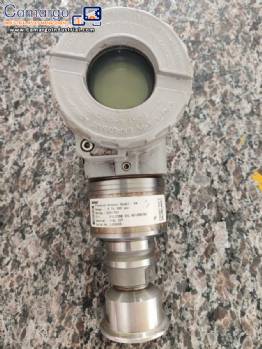 |
Brand: SMAR
Pressure sensor for measuring pressure in industrial processes.
Manufacturer | Brand: SMAR.
Model: S4.
Measurement range: 0 to 360 psi
Maximum pressure (rating): 2300 psi.
Filling fluid: Silicone oil DC-200/20.
Material: 316L SST st... |
|
|
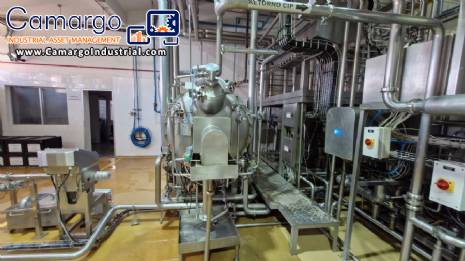 |
Brand: Alfa Laval, APV, Endress Hauser, Endress+Hauser, Kroma, NASH, Netzsch, Ricefer, SAMSON, SMAR, Spirax Sarco, Treu
|
|
|
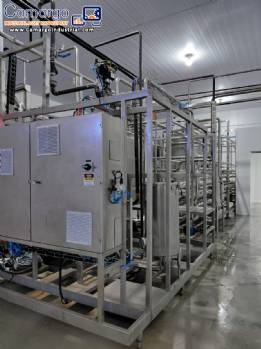 |
Brand: Alfa Laval, APV, APV SPX, Endress Hauser, Endress+Hauser, IFM, SPX
Industrial UHT ultra-high temperature pasteurization system with complete and overhauled tubular heat exchanger with retrofit.
Approximate capacity: up to 6,000 liters per hour.
For UHT thermal processing and ultra-high temperature pasteurizati... |
|
|
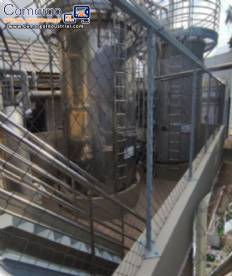 |
Brand: Alfa Laval, APV, Endress Hauser, Endress+Hauser, KHS, Spirax Sarco, Valmicro, Vortex
Automated CIP (Clean-in-Place) station for factories (such as food, chemical, and pharmaceutical) for internal cleaning of pipes, tanks, and equipment. Central station for large plants.
- CIP Station - Factory:
Composed of:
1 Jacketed tank f... |
|
|
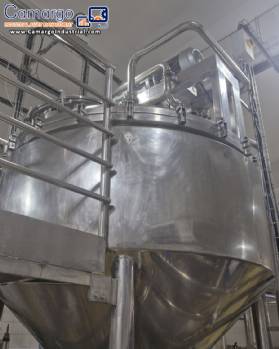 |
Brand: ECIL, Alfa Laval, Endress Hauser, Endress+Hauser, Nordix, SMAR
Jacketed stainless steel buffer/reactor tank with agitator/mixer.
Approximate capacity: 2,000 liters.
Year of manufacture: 2015.
Operating temperature: 120°C.
MAWP: 4 kgf/cm².
Model: Vertical cylindrical.
Top head: Flanged torispher... |
|
|
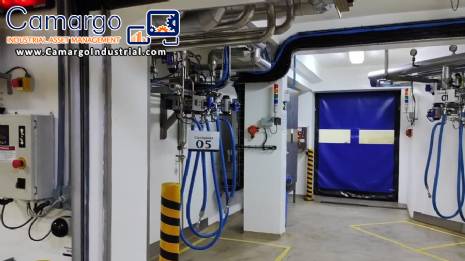 |
Brand: Endress Hauser, Endress+Hauser, Spirax Sarco
Container sterilization system.
Composed of:
– 30 Automatic stainless steel valves.
Manufacturer | Brand: Spirax Sarco.
– 6 Pressure transmitters and indicators.
Manufacturer | Brand: Endress + Hauser.
– 6 Temperature transmitters a... |
|
|
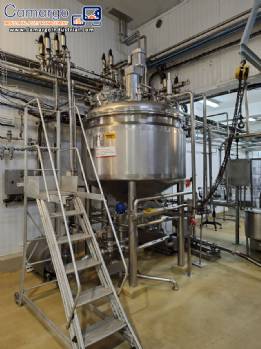 |
Brand: ECIL, Alfa Laval, Endress Hauser, Endress+Hauser, Inox Biaso, Nordix, SMAR
Jacketed stainless steel mixing/buffer reactor tank with agitation system.
Manufacturer/Brand: Inox Biaso.
Approximate capacity: 2,000 liters.
Material: AISI 304 Stainless Steel.
Operating temperature: 120°C.
MAWP: 4 kgf/cm².
Model:... |
|
|
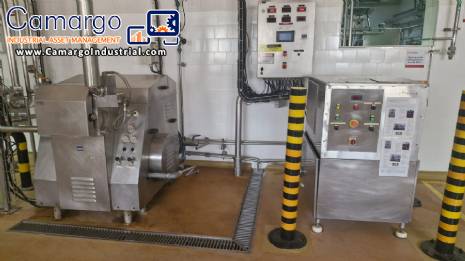 |
Brand: Artinox, Endress+Hauser, SMC, Treu
Homogenizer
Manufacturer | Brand: TREU.
Model: TM12.
With a 40 HP motor.
Includes:
– Artinox Homo-certified refrigeration system.
– SMC flow meter.
– 2 transmitters and pressure indicator – Endress+Hauser manufacturer.
– Level... |
|
|
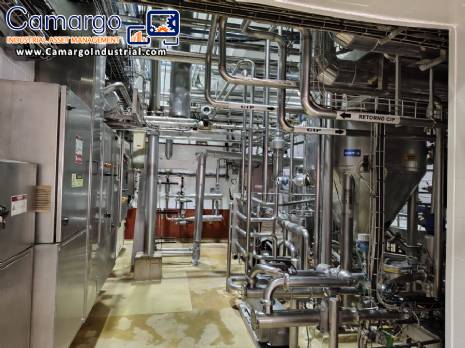 |
Brand: Alfa Laval, Endress Hauser, Endress+Hauser, SMAR, Tetralon, Valmicro
Reactor tank for processing food products, among others.
Composed of:
- 2 Mixing reactors with an approximate capacity of 1140 liters.
- 2 Reactor agitators, SEW manufacturer, with a 12.5 HP motor.
- 2 Tetralon lobe pumps, Tetralon manufa... |
|
|
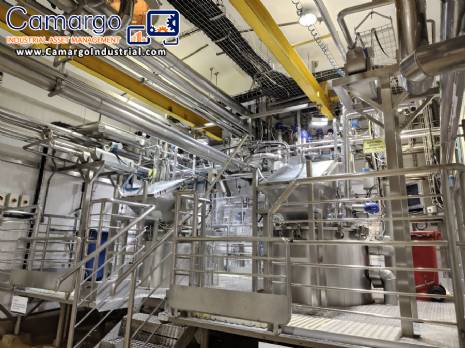 |
Brand: Alfa Laval, CIP, Endress Hauser, Endress+Hauser, Genova, Nordix, SAMSON, Spirax Sarco
Components: WEG
Production line system for various food products such as:
- Fruit preparations with or without pieces (pieces resistant to pumping);
- Toppings and sauces with or without pieces (pieces resistant to pumping);
- Injectable fillings for cakes ... |
|
|
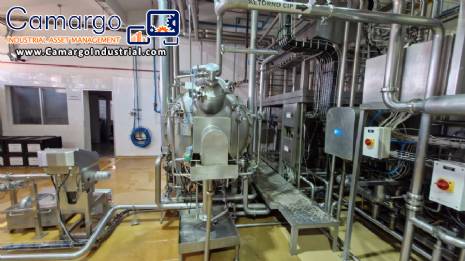 |
Brand: Alfa Laval, APV, Endress Hauser, Endress+Hauser, Loma Systems, NASH, SMAR
Automated system for preserving the integrity of products with chunks.
Set of industrial equipment for food processing, specifically designed to produce items with solid chunks that do not break down during the process.
Approximate capacity: 45... |
|
|
| |
| |
|