Introduction and Thermodynamic Fundamentals
Lyophilization, or cryodesiccation, is a thermal separation process based on the removal of water or other solvents through a direct transition from the solid to the gaseous state, without passing through the liquid phase (sublimation). This phenomenon occurs under controlled pressure and temperature conditions, operating below the triple point of water—the thermodynamic point at which the solid, liquid, and gaseous phases coexist at 0.01°C and 0.006 atm.
For complex biological formulations, the process is not restricted to pure water, involving matrices with sugars, salts, and proteins. In these cases, the critical parameter is the collapse temperature or the glass transition temperature of the frozen concentrated solvent. If the product temperature exceeds this critical limit during primary drying, the amorphous or crystalline structure will collapse, resulting in loss of cake porosity, increased residual moisture, and irreversible degradation of the vaccine's biological activity.
2. Operating Principle and Process Dynamics
The industrial freeze-drying cycle is divided into three rigidly sequenced macro-stages monitored by automated systems.
Phase 1: Freezing (Solidification)
The liquid product, packaged in vials, is placed on the shelves of the chamber, which initiate cooling by thermal conduction until reaching ranges between -40°C and -55°C. The objective is to freeze all free water and fix the solute matrix. The cooling rate determines the nucleation kinetics and the size of the ice crystals:
Rapid Freezing: Generates smaller crystals, which reduces mechanical stress on live cells or viruses, but creates narrow microchannels that increase resistance to vapor flow in the next stage, prolonging drying.
Slow Freezing: Produces larger crystals and wide channels that facilitate sublimation, however, excessive crystal growth can rupture cell membranes or denature proteins.
Phase 2: Primary Drying (Sublimation)
After complete solidification, the vacuum system is activated to reduce the internal pressure of the chamber to levels typically between 0.05 mbar and 0.2 mbar. Simultaneously, the condenser coils are cooled to temperatures below -60°C. With the pressure differential established between the chamber and the condenser, controlled heating of the shelves begins using a thermal fluid. This heat provides the latent heat of sublimation necessary to convert the ice into vapor. The vapor migrates at high speed to the condenser, where it deposits and solidifies on the cold surface of the coils, freeing the vacuum shelves from this gas charge.
Phase 3: Secondary Drying (Desorption)
After the elimination of all free ice, what remains is water chemically bound by adsorption to the molecular walls of the solute. To remove it without causing thermal damage, the vacuum is brought to its maximum limit (lowest possible pressure) and the shelf temperature is raised to ranges between 25°C and 40°C. The process continues until the residual moisture of the product reaches safe levels, generally between 0.5% and 3%.
3. Biotechnological Applications: Types of Vaccines and Medicines
The thermal sensitivity of antigens and adjuvants makes lyophilization the standard method for extending the stability of high-value pharmaceutical and veterinary formulations.
Human Medicine
Attenuated Viral Vaccines: The virus remains alive, but weakened. Liquid heat would destroy its ability to replicate safely. Commercial examples: Measles, Mumps and Rubella (MMR) vaccine, Yellow Fever vaccine, Varicella vaccine and oral rotavirus vaccine.
Subunit and Conjugate Vaccines: Formulations containing specific fragments of bacterial proteins or polysaccharides. Examples: Meningococcal ACWY Vaccine and Pneumococcal Conjugate Vaccine.
Sterile Injectable Medications: Latest generation antibiotics (such as cephalosporins and carbapenems), botulinum toxin, recombinant hormones, monoclonal antibodies (mAbs), and blood clotting factors.
Veterinary Medicine
Avian Vaccines: High-volume lines focused on controlling pathogens in industrial farms. Examples: Newcastle Disease Vaccine, Avian Infectious Bronchitis Vaccine, and Gumboro Disease Vaccine.
Vaccines for Production Animals (Cattle, Swine, and Sheep): Prevention of systemic diseases that cause losses in livestock farming. Examples: Brucellosis vaccine (B19 strain), Anthrax vaccine, and Classical Swine Fever vaccines.
Vaccines for Companion Animals (Pets): Polyvalent complexes for dogs and cats. Examples: Canine V10/V8 vaccine (lyophilized fractions of Distemper, Parvovirus, and Coronavirus) and the Feline Diphtheria-Tetanus vaccine.
4. Construction Engineering, Materials, and Critical Components
The construction of an aseptic freeze dryer follows strict sanitary engineering criteria to withstand extreme pressures.
Vacuum, positive sterilization pressures, and abrupt temperature variations.
Construction Materials
Stainless Steel: All surfaces in direct contact with the product or its vapors (chamber interior, condenser, shelves, and piping) are mandatorily manufactured from AISI 316L stainless steel. The internal finish requires mechanical polishing followed by electropolishing, resulting in an extremely low surface roughness (Ra less than or equal to 0.4 micrometers), which prevents the adhesion of biofilms and residues. External support structures use AISI 304 stainless steel.
Seals and Gaskets: Employ high-performance elastomers, predominantly Platinum Cured Silicone or EPDM, capable of withstanding continuous freeze-thaw cycles at -55°C and steam sterilization at 121°C to 135°C without exhibiting drying, loss of elasticity, or particle shedding.
Mechanical Components and Subsystems
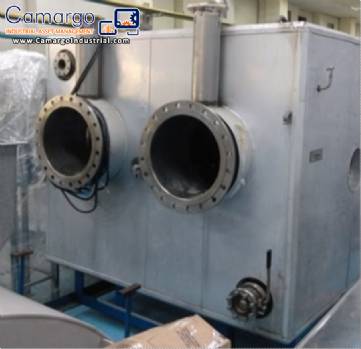
Drying Chamber: Rectangular or cylindrical vessel designed to operate under absolute vacuum and positive pressures up to 3.5 bar (necessary for steam sterilization). Features doors with tempered borosilicate glass viewing windows and a pneumatic locking system.
Shelves and Thermal System: Machined plates with internal zigzag channels through which low-viscosity silicone oil circulates. A set composed of heat exchangers, electric resistors, and circulation pumps ensures that the thermal gradient between different points on the same shelf is less than 1°C, ensuring batch homogeneity.
Steam Condenser: Positioned attached to the side or below the main chamber. It is isolated from it by a large-diameter sanitary butterfly valve (steam passage valve). Contains bundles of coils or plates directly cooled by the refrigeration system to trap water vapor in the form of ice.
Vial Closing Mechanism (Stoppering): An internal hydraulic piston or pneumatic bellows located at the top of the chamber pushes the shelves vertically at the end of the cycle. The shelves compress and press the rubber stoppers (which have lateral grooves for steam release) into the neck of the vials, sealing the entire batch under vacuum or inert gas (pharmaceutical grade nitrogen).
CIP and SIP Cleaning Systems: The freeze dryer has internal manifolds with rotating spray nozzles (spray balls) connected to a CIP (Clean-in-Place) system for automatic washing with water for injection (WFI). Subsequently, the SIP (Sterilize-in-Place) system injects clean saturated steam into the chamber and condenser, raising the internal temperature to 121°C for at least 20 minutes to ensure complete sterilization of the environment before the next batch.
5. Sizes, Dimensions, and Configuration Differences
Equipment is configured to meet different production demands and levels of automation.
Classification by Size
Pilot/Laboratory: Shelf areas between 0.1 square meters and 1.5 square meters. Condensers with a capacity of 2 to 20 kg of ice per cycle. Used for stability testing, formulation development, and small-scale batches.
Medium-Sized Industrial: Shelf areas between 2 square meters and 15 square meters. Process 15,000 to 60,000 vials per cycle. Common in national veterinary laboratories and manufacturers of injectable products under contract.
Large-Sized Industrial: Shelf areas between 20 square meters and more than 60 square meters, with condensers for more than 800 kg of ice. They operate in continuous cycles integrated with automated robotic loading and unloading systems (ALUS) using fixed conveyors or automated guided vehicles (AGVs) in areas isolated by physical barriers (RABS) or closed isolators.
Technical Differences: Human Pharmaceutical versus Veterinary
Sterilization Requirement (SIP): In the human pharmaceutical segment, CIP and automated SIP systems are mandatory by regulatory bodies for any injectable. In the veterinary sector, although SIP is the standard for most live vaccines, some lines focused on non-sterile solutions or ectoparasiticides operate with freeze dryers that use only simplified chemical sanitization (CIP), reducing the asset acquisition cost.
Biological Containment: Live virus veterinary vaccines (such as foot-and-mouth disease or highly contagious avian strains) require the freeze dryer to function as a negative biological containment barrier. Vacuum lines are fitted with dual HEPA exhaust filters with in-situ filter sterilization systems to prevent the escape of live microorganisms during vacuum pump purging.
6. Technical Study: Advantages and Disadvantages of the Technology
Advantages
Preservation of Biological Activity: The absence of high thermal heat prevents protein denaturation, the inactivity
Advantages: Viral antigen inhibition and degradation of sensitive active ingredients.
Superior Physical Structure (Porosity): Because water is removed by direct sublimation from the frozen state, the original volume of the product is maintained. Material shrinkage does not occur, resulting in a highly porous cake that dissolves instantly (reconstitution) upon contact with the diluent.
Long-Term Stability: With extremely low residual moisture levels and sealing under an inert atmosphere or vacuum, products are protected against oxidation and hydrolysis, allowing for long-term storage at common refrigeration temperatures (2°C to 8°C) or even at room temperature, eliminating the need for ultra-cold chains (-70°C).
Disadvantages:
High Capital Investment Cost (CAPEX): Pharmaceutical freeze dryers are among the most expensive equipment in an industrial plant due to metallurgical complexity, redundant refrigeration and vacuum systems, and the required sanitary automation. High Operating Costs (OPEX): The freeze-drying cycle is energy inefficient and time-consuming. A single batch can require 24 to over 72 continuous hours of operation of refrigeration compressors, vacuum pumps, and heating systems, generating high electricity consumption.
Process Development Complexity: Each formulation requires prior mapping of its thermal properties in the laboratory for the detailed design of freezing ramps, drying times, and vacuum levels. Minimal operational errors can cause thermal collapse of the batch, rendering extremely high-cost products unusable.
7. Global and National Manufacturer Landscape
The aseptic freeze-drying market is highly specialized, with brands that dictate global technological standards and national options focused on local support.
International Manufacturers (Market Leaders)
IMA Life (Italy): A division of the IMA Group that incorporated the renowned freeze-drying engineering of BOC Edwards Pharmaceutical Systems. It is one of the most traditional brands in the world, recognized for developing industrial freeze dryers integrated with aseptic isolators and robotic loading systems. It has a very high resale value in the used market.
Syntegon (Germany): Formerly Bosch Packaging Technology. Manufactures freeze-drying systems integrated into its high-speed filling lines, focused on mechanical precision, vacuum efficiency, and strict regulatory compliance.
Telstar (Spain / Azbil Group): A brand with a strong presence in Latin America. Manufactures freeze dryers ranging from laboratory scale to large industrial capacities. Its Lyosuite control system is widely praised for its interface and freeze-drying recipe management.
GEA Lyophil (Germany): A division of the GEA group specializing in large-scale freeze-drying for the global pharmaceutical industry. Its equipment uses state-of-the-art proprietary technologies for energy optimization and internal shelf movement via frictionless magnetic coupling.
SP Scientific (USA): Conglomerate that owns iconic freeze-drying brands such as Virtis, Hull, and FTS Systems. Its lines of small to medium-sized pilot and industrial freeze dryers are highly valued in the market for their durability and ease of maintenance.
Tofflon (China): Asian manufacturer with strong global expansion. It has gained significant market share in generic drugs, biosimilars, and veterinary vaccines by offering large-scale equipment in compliance with international guidelines, presenting a competitive cost-benefit ratio.
Manufacturer Landscape and National Support (Brazil)
In the Brazilian market, the development of large-scale industrial freeze dryers with complete SIP systems in electropolished 316L stainless steel faces direct competition from European parent companies. However, there are national engineering companies and manufacturers that stand out in the supply of small and medium-sized freeze dryers, as well as in the retrofit market and specialized technical assistance:
Liobras: One of the main national references in the manufacture of freeze dryers, with a strong presence in benchtop, laboratory and small-scale pilot plant equipment aimed at research centers, universities and smaller-scale pharmaceutical and biotechnological laboratories.
Terroni: A traditional national manufacturer focused on the development of freeze-drying equipment for laboratories, smaller pharmaceutical industries, tissue banks and functional food processing.
Engineering and Retrofit Companies (Industrial Support): The Brazilian industrial market has local integrators and companies specializing in vacuum and industrial automation that perform complete modernization services on old imported freeze dryers (such as the classic Edwards Alto Vuoto models). These and Companies are replacing discontinued original controls with modern systems based on national PLCs and supervisory software compliant with current standards, extending the operational lifespan of assets with local technical support.
8. Control, Automation and Regulation Systems
The management of a pharmaceutical freeze dryer is performed by industrial Programmable Logic Controllers (PLCs) connected to computers with SCADA (Supervisory Control and Data Acquisition) systems.
Critical Control and Instrumentation Parameters
Vacuum Sensors: Use of combined technologies for greater precision. Pirani-type sensors (based on the thermal conductivity of the gas) are used together with capacitance manometers (MKS Baratron, which measure the actual pressure independent of the gas composition). The difference in readings between the two sensors indicates the end of primary drying, as water vapor alters the thermal conductivity measured by the Pirani.
Temperature Sensors (PT100): High-precision platinum sensors calibrated and distributed both inside the shelves and inserted directly into witness vials (product probes) to record the actual temperature of the product cake throughout the entire cycle.
Gas Admission Control (Venting): High-precision proportional valves that control the controlled entry of sterile nitrogen to break the vacuum at the end of the process or to perform pressure fluctuation cycles (controlled vacuum) to optimize secondary drying.
Regulatory and Normative Aspects
Anvisa RDC 658/2022: Brazilian Good Manufacturing Practices (GMP) regulation aligned with the international PIC/S. This requires rigorous validation of the control software, installation qualification (IQ), operational qualification (OQ), and performance qualification (PQ) of the freeze dryer, including periodic vacuum tightness tests (pressure rise test) and sterility validation of the SIP cycle through the use of bioindicators (Geobacillus stearothermophilus).
FDA 21 CFR Part 11 (USA): Mandatory requirement for the export of pharmaceutical products and adopted as a standard by major national industries. It stipulates that all electronic records generated by the freeze dryer must be tamper-proof. The automation system must have hierarchical password access levels, automated saving of batch reports, and generation of an audit trail, electronically recording any setpoint changes, alarms, or actions performed by operators during the production cycle. |