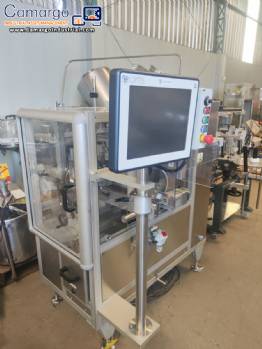
2D Serialization Systems, Machine Vision Inspection, Pharmacode, and Variable Data Printing
2D serialization systems, machine vision inspection units, and variable data printing modules form the core infrastructure for quality assurance and traceability in advanced manufacturing. Designed to operate online at high speeds, these automated Print and Check stations ensure complete pharmaceutical traceability compliance with ANVISA regulations as well as international standards such as the Brazilian National Pharmaceutical Control System (SNCM), ANVISA RDC 301, US FDA DSCSA 21 CFR Part 11, and EU FMD 2016/161. The primary goal is to eliminate printing errors, prevent supply chain counterfeiting, and avoid accidental packaging mix-ups through automated anti-mix-up controls.
Operating Principle, Electro-Optical Mechanics, and Vision Control
The operation of a standalone or inline inspection station relies on millisecond synchronization between mechanical transport, industrial coding, optical image capture, and digital vision processing.
Sequential Operating Process:
Package Infeed: The container or carton is fed onto the machine conveyor.
Side-Belt Stabilization: Synchronized side-belts clamp the package firmly to eliminate vibration.
Encoder Speed Tracking: A rotary incremental encoder measures conveyor speed in real time.
Photoelectric Sensor Trigger: A photo-eye detects the leading edge of the container.
Thermal Inkjet (TIJ) or Laser Marking: Variable data is printed with high precision.
GigE Camera and LED Strobe Capture: The printed area is illuminated and frozen without motion blur.
Digital Vision Processing: Algorithms validate 2D DataMatrix quality, OCR/OCV text, and Pharmacode.
Pass/Fail Decision: Approved items continue downstream; non-compliant items are ejected by a failsafe pneumatic rejector into a locked reject bin.
A. Mechanical Stabilization and Transport
Optical inspection accuracy requires absolute physical stability at the lens focal point.
Folding Carton Serialization: Uses synchronized side-belt drive modules, as found in systems like the Optel CartonTracker. Micrometric width adjustment prevents pitch and yaw oscillations during high-speed travel.
360-Degree Bottle and Vial Inspection: Glass vials (Type I, II, III), HDPE, or PET bottles utilize timing screws, starwheels, or top hold-down belts to keep containers centered in the vision Field of View (FOV).
Effervescent Tube and Tubing Inspection: Aluminum tubes, coextruded plastic tubes, or Vitamin C tubetes are transported via custom pucks or rotation rollers for peripheral inspection of the crimp seal and desiccant cap.
B. Synchronization, Triggering, and Variable Data Printing
Rotary Incremental Encoder: Connected to the drive shaft, it outputs continuous pulses per millimeter to dynamically adjust printer firing rates.
Photoelectric Sensor (Trigger): Detects the package edge and fires the Thermal Inkjet (TIJ) printer (such as Domino Gx-Series, Markem-Imaje 1050/1200, or Videojet Wolke m600), printing GS1 DataMatrix codes, unique serial numbers, batch numbers, and expiration dates.
C. Optical Capture and Inspection Algorithms
Milliseconds after marking, the printed area enters the inspection zone:
GigE Vision Industrial Camera and LED Strobe Light: High-speed matrix cameras (such as Optel PharmaProof, Cognex DataMan 370/470, or Keyence XG-X) operate synchronously with a ring LED strobe to freeze motion and eliminate blur.
ISO/IEC 15415 DataMatrix Grading: Evaluates symbol contrast, modulation, fixed pattern damage, and Reed-Solomon error correction in real time. Codes below the minimum grade threshold are rejected.
OCR/OCV Algorithms (Optical Character Recognition / Verification): OCR extracts human-readable text; OCV compares printed pixel matrices against approved templates to reject missing, smudged, or incorrect characters.
Pharmacode Reading: Verifies one-dimensional pharmaceutical binary codes (Pharmacode). Software analyzes bar proportions to confirm that cartons, labels, or leaflets match the active batch, ensuring robust anti-mix-up control.
D. Active Rejection with Failsafe Pneumatic Actuator
Defective packages are rejected by a failsafe pneumatic actuator (push rod, air jet, or reject wheel). If air pressure drops, power fails, or the reject bin fills up, the conveyor stops immediately, while reject confirmation sensors confirm physical entry into the locked bin.
Vertical Traceability and Software Architecture (Levels 1 to 5)
Machine vision inspection and serialization require seamless integration between floor equipment and enterprise IT systems:
Level 1 - Field Devices: Photoelectric sensors, encoders, pneumatic actuators, matrix vision cameras, and TIJ coders on the machine frame.
Level 2 - Line Controller and HMI Software: Local industrial controllers, such as Optel LineMaster, managing hardware timing, processing vision algorithms, and tracking reject queues in real time.
Level 3 - Site Management and Plant Server: Central facility server allocating serial number batches and managing Computerized System Validation (IQ OQ PQ) data and Audit Trail logs.
Level 4 - Enterprise ERP and Serialization: Corporate enterprise platforms (e.g., SAP ATTP - Advanced Track and Trace for Pharmaceuticals) managing global unique identifier lifecycles.
Level 5 - Government and Regulatory Repositories: Official portals (such as ANVISA SNCM, US FDA DSCSA, or EU FMD) receiving production, commission, and decommission reports via EPCIS and XML protocols.
Packaging Formats and Engineering Challenges
Folding Carton Serialization: Applied to duplex/triplex paperboard and corrugated boxes. Executes 2D DataMatrix printing and reading on side flaps, OCR/OCV of Lot/Exp, and internal Pharmacode verification. Challenge: maintaining dimensional stability above 300 ppm without losing camera focus.
360-Degree Bottle and Vial Inspection: Applied to Type I/II/III glass, HDPE, and PET. Executes label reading on rotating containers, bottom coding, tamper-evident seal checks, fill level inspection, and label Pharmacode reading. Challenge: cylindrical surfaces require multi-camera arrays or guided rotation.
Blister Pack Inspection: Applied to Alu-Alu, PVC/PVDC, and PET blisters. Checks tablet presence/absence, cracks, color, seal integrity, and aluminum foil print coding. Challenge: metallic reflections require dome lighting and polarized illumination filters.
Effervescent Tube Coding: Applied to deformable aluminum and rigid plastic tubes. Executes printing on crimp seals or tube bodies with desiccant cap validation. Challenge: precise mechanical orientation to align the flat print surface with the 2D DataMatrix matrix reader.
Sachet and Flexible Packaging Inspection: Applied to laminated films, pouches, and flow-packs. Executes code reading on flexible substrates, seal integrity verification, and artwork centering. Challenge: uneven surfaces require smoothing algorithms and low-angle lighting.
Shipper Case and Pallet Aggregation: Applied to corrugated cases and pallets. Executes parent-child hierarchical aggregation with GS1-128 and SSCC (Serial Shipping Container Code) label printing and reading. Challenge: reading wide areas via Large FOV cameras or manual verification with handheld scanners (Datalogic PowerScan PD9531).
Industrial Sector Applications
Human Pharmaceutical Industry: Mandatory implementation across solid oral, liquid, injectable, and topical lines for unit-level traceability, anti-counterfeiting, and packaging/leaflet anti-mix-up.
Veterinary Industry (Animal Health): Tracking of vaccines, antibiotics, and remedies to ensure cold chain integrity and export compliance.
Cosmetics and Dermocosmetics: Applied to premium fragrances and skincare lines for grey market protection, brand protection, and aesthetic label verification.
Agrochem and Fine Chemicals: Tracking of pesticides, crop protection products, and hazardous chemicals for transport safety and environmental regulation.
Food and Nutraceuticals: Used in infant formula and dietary supplements to enable targeted precision recalls and high-speed batch management.
OEE Efficiency Analysis, Advantages, and Risk Mitigation
Overall Equipment Effectiveness (OEE) Impact:
Quality: Approaches 100% as the failsafe pneumatic rejector prevents unreadable, low-grade, or misprinted items from passing downstream.
Performance: Can experience slight reductions if vision algorithms are over-configured, raising the False Reject Rate (FRR).
Availability: Optimized in modern stations through digital position indicators that reduce setup time during product changeovers.
Key Advantages:
Full Regulatory Compliance: Complete alignment with ANVISA, US FDA, and European Union regulations.
Elimination of Mass Recalls: Pinpoint identification of affected serial numbers allows targeted recalls of only compromised units.
Operational Safety: Guarantees no package leaves the line without verified Pharmacode or OCR/OCV validation.
Ecosystem of Manufacturers, Platforms, and Key Models
Integrated Station Manufacturers:
OPTEL Group: Optel CartonTracker station, Optel LineMaster line controller, and Optel PharmaProof vision system.
Mettler-Toledo PCE: PCE T2610 and T2620 stations, and PCE Line Manager software.
Antares Vision: Print and Check series (P&C EVO) and Antares Matrix Suite software.
Laetus GmbH: MV-50 modules, S.A.M. units, and the ARGUS Pharmacode inspection system.
WIPOTEC-OCS: TQS (Traceable Quality System) line, such as model TQS-HC-A combining checkweighing and serialization.
Vision Peripherals, Scanners, and Printers:
Vision Cameras and Scanners: Cognex DataMan 370/470, Datalogic Matrix imagers, Datalogic PowerScan PD9531 handheld industrial scanners for aggregation, and Keyence XG-X vision systems.
Printers and Coders: Thermal Inkjet printers including Domino Gx-Series, Markem-Imaje 1050/1200, Videojet Wolke m600, and Videojet 8520/8610. |